perFOAMance - Moving Toward Price Parity in Food Technology: Optimizing Cell Culture Performance Using Vegetable Antifoams
A research project of Leibniz Universität Hannover in cooperation with Cultimate Foods
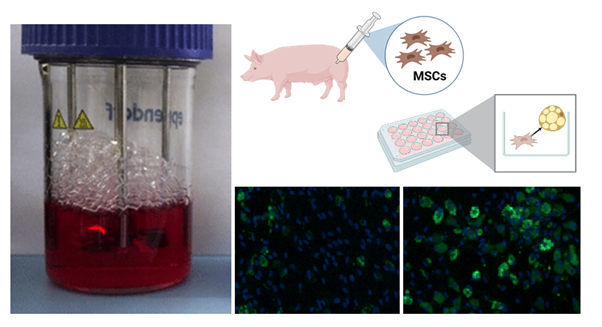
By 2050, global demand for meat is expected to rise sharply, posing significant challenges to conventional livestock farming. Ethical concerns regarding animal welfare, sustainability, and health underscore the urgent need for technological alternatives to conventional meat production. In this project, we focused on animal cell culture technologies—one of the key solutions for sustainable food production.
Food-Grade Defoaming Solutions for Cellular Agriculture
A major bottleneck in the large-scale production of cultured cells is foam formation in bioreactors, which negatively impacts cell viability, differentiation, and product yield. Foam also creates operational issues by reducing reactor volume, hindering oxygen and heat transfer, and compromising sterility. The aim of this project was to replace conventional chemical antifoams—which are costly and may impair cell growth—with food-grade, plant-based agents better suited for cellular agriculture and food technology.
We systematically selected and tested ten certified plant-based antifoams. Four emerged as optimal candidates, showing no in vitro cytotoxicity and even enhancing the viability of porcine mesenchymal stem cells in conventional 2D cultures. Upon addition, these plant-based antifoams acted as effective defoamers, promoting immediate bubble coalescence and foam breakdown, enabling reliable cell growth without compromising cell adhesion in 2D or 3D cultures. Notably, some antifoams enhanced lipid accumulation during adipogenic differentiation, supporting efficient production of in vitro porcine fat.
Our study included samples from leading German producers and demonstrated that these plant-based antifoams are suitable for cell-based food applications. The project succeeded in identifying bioprocess-supporting, cost-effective, and scalable antifoam solutions, bringing the field closer to consistent, reproducible cellular agriculture and precision fermentation. The results provide a foundation for further optimization of food-grade antifoams, with relevance for a wide range of cell-based food and fermentation products.
Leibniz University Hannover, Institute of Technical Chemistry
Project leader: PD Dr. Antonina Lavrentieva
Cooperation partner: Cultimate Foods GmbH
Download
Final Report: LUH_Cultimate_perFOAMance_Report
Publication: Schilling, Maria, et al. "Evaluation of Food-Grade Antifoams for Biocompatibility, Differentiation, and Bioprocess Performance in Porcine Mesenchymal Stem Cell Cultivation for Cellular Agriculture." Journal of Food Engineering (2026): 113234.